



Marketing a therapy practice can get overwhelming quickly.
There are dozens of things you could do.
Post on Instagram.
Start a newsletter.
Write blogs.
Run Google Ads.
Join more directories.
Network.
Make videos.
Improve your website.
The problem is that doing more does not always lead to more clients.
A better approach is to focus on a few channels that can actually help the right people find you and feel confident enough to reach out.
Here are seven marketing ideas for therapists that are worth prioritizing.
1. Improve Your Google Business Profile
If you see clients locally, your Google Business Profile can be one of the most important parts of your marketing.
When someone searches for:
- therapist near me
- anxiety therapist near me
- couples counselor near me
- trauma therapist near me
Google often shows local results before traditional website listings.
That means your profile should be complete, accurate, and connected to the rest of your online presence.
Make sure your:
- business name is correct
- phone number is current
- website is linked
- hours are accurate
- services are listed
- business category makes sense
- photos look professional
Your website should also clearly explain where you practice and what services you provide.
The easier you make it for Google to understand your practice, the better your chances of appearing for relevant local searches.

3. Use Google Ads for High-Intent Searches
Google Ads can work well for therapists because they can put your practice in front of people who are already looking for help.
That is very different from trying to interrupt someone on social media.
Someone searching:
“anxiety therapist near me”
is already much closer to taking action.
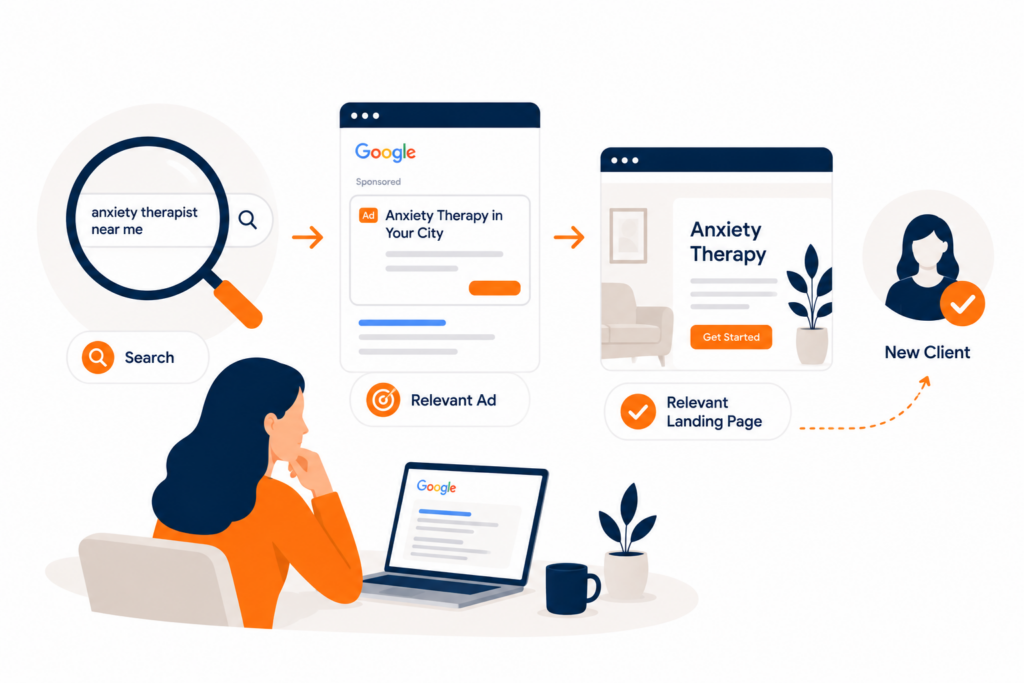
The key is matching the search to the right page.
A strong flow might look like:
Search → Relevant Ad → Relevant Service Page → Clear Call to Action
For example, a couples counseling ad should ideally lead to a couples counseling page, not a generic homepage.
That usually makes the experience more relevant and gives the person fewer reasons to leave.
You can learn more about our Google Ads management services.
If you are considering Google Ads but are not sure whether it makes sense for your practice or market, schedule a free 30-minute strategy session. We can look at your location, services, competition, and current marketing before you decide what to do next.
5. Write Content Around What Clients Actually Search
Blogging can help with SEO, but only if the topics match what people are actually searching for.
A common mistake is writing content based only on what sounds interesting.
A better approach is to answer questions potential clients are already asking.
For example:
- How do I know if I need therapy for anxiety?
- Can couples therapy help after infidelity?
- What happens during your first therapy session?
- How long does EMDR take?
- What type of therapist should I see for trauma?
- Can therapy help with panic attacks?
These topics can attract people who are already considering therapy.
The goal is not just to educate.
The goal is to help someone feel that reaching out to a therapist is the right next step.
You can see more examples of marketing-focused content on the J Curve Advertising blog.

7. Track Which Marketing Actually Produces Clients
This is where many practices get stuck.
They track:
- website traffic
- clicks
- impressions
- followers
- form submissions
But those numbers do not tell you whether the marketing is actually growing the practice.
You should ideally know:
- where each lead came from
- how many leads scheduled
- how many became clients
- which services generate the best inquiries
- which channels produce the most clients
- how much it costs to acquire a new client
For example, one channel may generate 30 leads and only 3 clients.
Another may generate 12 leads and 8 clients.
The second channel may be far more valuable even though the lead count is lower.
Marketing gets much easier when you know what is actually working.