

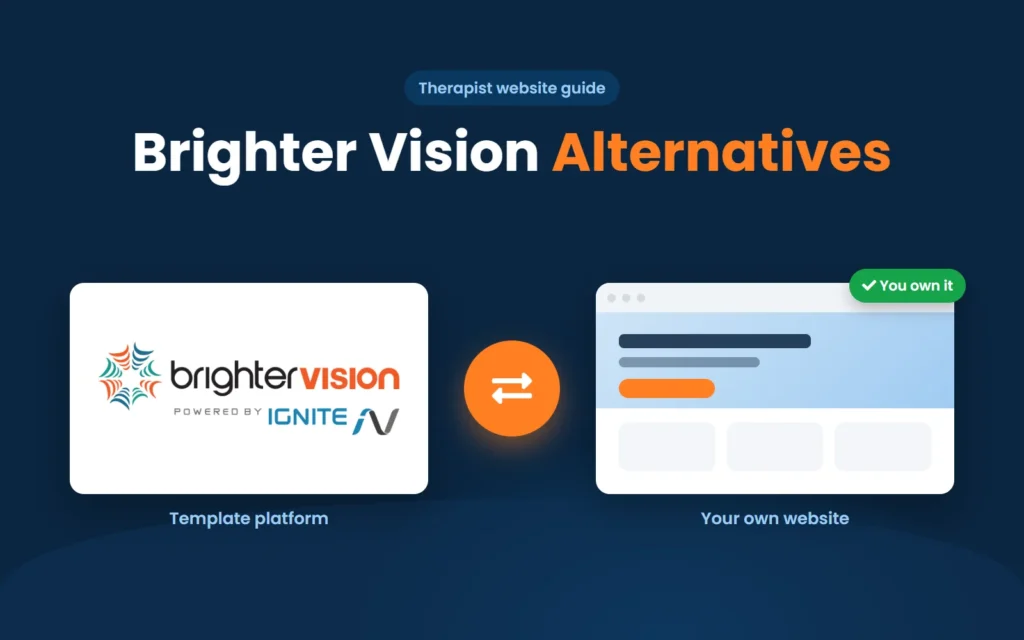
If you are searching for Brighter Vision alternatives, you are probably not casually comparing website companies.
You may already be paying Brighter Vision every month. Your website may look a lot like other therapist websites. You may have asked support for a simple change, waited several days, and received an edit that still was not what you asked for. Then you explained it again and waited again.
That is usually the point when therapists start looking for something else, and it is often the point when they find us.
What We Have Noticed About Brighter Vision Websites
We build websites and run marketing only for therapists and mental health practices, so we see a lot of existing therapist websites. When a practice comes to us from Brighter Vision, the same things tend to come up:
- The sites look alike. Many use the same recognizable template structure. The colors, photos and text change, but the layout feels very similar from one practice to the next, and the pre-written content can read the same too.
- They have not been kept in good shape. Pages are out of date, formatting is inconsistent, calls to action are weak, and the site no longer reflects the services or the team accurately.
- Support can turn into its own workload. In the situations we have seen, a simple edit could take several days, and the change did not always come back the way it was requested. That means another message, another wait and another round of corrections. If the reason you chose a done-for-you service was to save time, that undermines much of its value.
- The website is rented, not owned. You keep your domain and the content you supplied, but the working website stays with Brighter Vision. When you stop paying, it comes down and you have to rebuild.
That does not mean every Brighter Vision website looks the same or that every customer gets slow support. A therapist who requests updates regularly can keep the site current. But these patterns explain why so many practices eventually decide they want a website they control, built by a team that knows it closely.
This guide compares Brighter Vision with the main alternatives therapists use in 2026: what each one costs, who builds and owns the site, and which practices each suits. At the end, you will find a checklist for switching without losing your domain, content, email or Google rankings.
Prices last checked: November 2026, using each company’s own pricing page where available. Website companies change plans and promotions often, so confirm the current offer and contract before you sign.
The Short Answer
If you are frustrated enough to search for Brighter Vision alternatives, there are better options:
- Our recommendation for most practices: a custom WordPress website that you own, built by a team that knows therapy practices. J Curve builds one for a one-time fee of $397, or includes it with our Google Ads management, and hands you the login so the website is yours.
- You want a done-for-you site at a low monthly price: TherapySites is the closest like-for-like alternative. Choose it only if you want something very similar to Brighter Vision. If you are looking for alternatives, you probably need something different.
- You are comfortable building it yourself: Squarespace or Wix, plus a HIPAA-compliant form or client portal for anything clinical.
- Avoid AI website builders if you want new clients. They are cheap, but the sites look the same and are rarely found on Google.
The important part is leaving without losing your domain, your content, your Google rankings or your working email. We can help with that: we review what you have, create a transition plan, and write the exact request to send Brighter Vision for your domain, content, account details and analytics access. Then we rebuild the site on WordPress, set up the redirects, and give you the administrator credentials.
Get a free website migration consultation
Brighter Vision Alternatives at a Glance
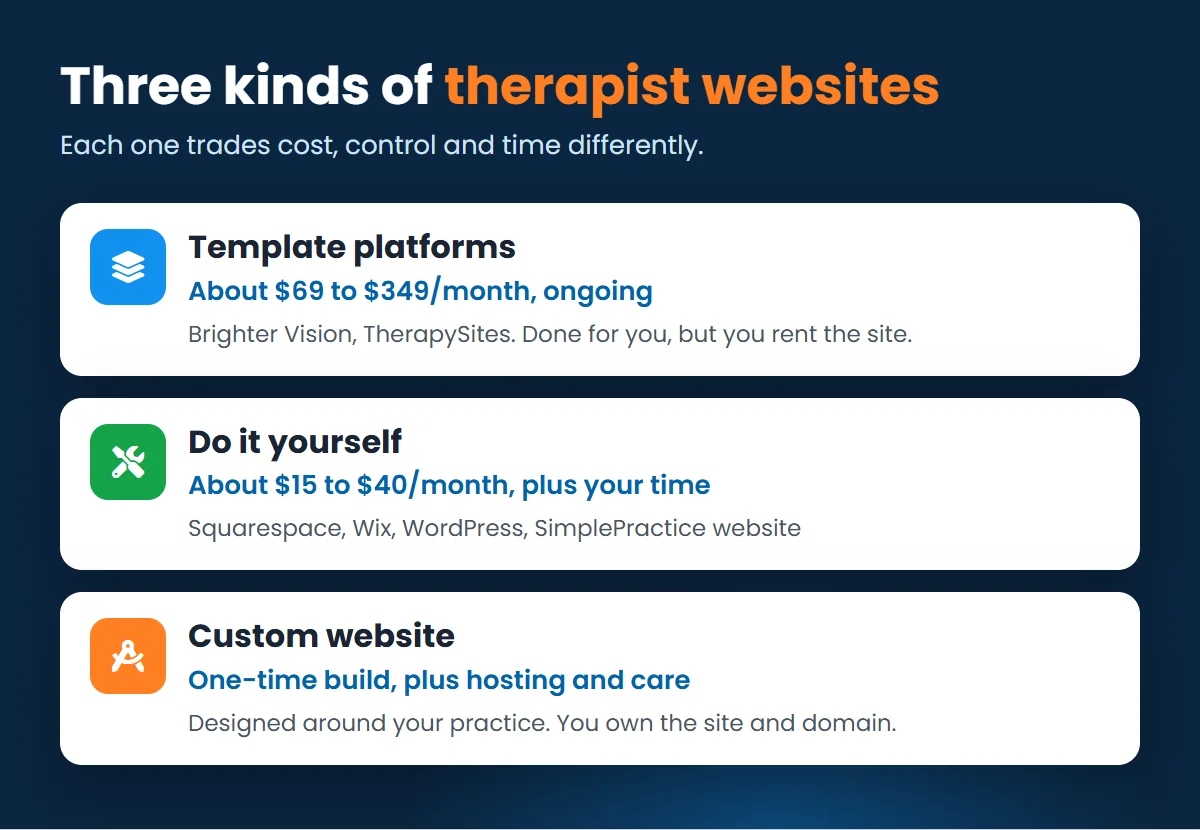
| Option | Typical cost | Who builds it | Best for |
|---|---|---|---|
| Brighter Vision | From $99/month ($78/month billed annually) plus a $100 setup fee | Brighter Vision, from therapist templates | Therapists who want a hands-off, therapist-specific package |
| TherapySites | Packages from $69/month | TherapySites, from therapist templates | Something very similar to Brighter Vision at a lower starting price |
| SimplePractice website | Included with SimplePractice plans ($49 to $99/month) | You, with simple templates | A basic page connected to your SimplePractice account |
| Squarespace | Roughly $15 to $40/month | You | Design-minded therapists who enjoy doing it themselves |
| Wix | Roughly $17 to $40/month | You | DIY builders who want lots of add-ons |
| WordPress (self-built) | Hosting from about $10 to $30/month, plus a theme and plugins | You | Technical therapists who want full ownership |
| AI website builder | Often around $10 to $30/month | An AI tool, from a few prompts | A temporary placeholder. Sites look the same and are rarely found on Google |
| Custom website from an agency | Often $2,200 to $4,500 one time for a solo practice, plus hosting and care | A designer or agency | Practices that want the website to bring in clients |
| J Curve Advertising website Best option | $397 one time, or included with our Google Ads management. The website stays yours forever | J Curve, custom for your practice | Therapists who want a website they own, built to bring in clients |
Brighter Vision: What You Get and What It Costs

Brighter Vision builds websites and marketing for therapists, psychologists and counselors. Its plans in 2026, from its own pricing page:
- Start: $99/month, or $78/month billed annually, plus a $100 setup fee. Includes the website, hosting, SSL, a domain, a pre-written content library, ready-made forms and two email addresses.
- Grow: $179/month, or $143/month billed annually, plus a $100 setup fee. Adds more email addresses and a social media tool.
- Flourish: $349/month, or $299/month billed annually. Adds HIPAA-compliant forms and email through Hushmail, a GoodTherapy Pro membership and one optimized content page per month.
- Thrive & Prosper: custom pricing. Adds SEO, content planning, advertising and monthly reporting.
What it does well: one company handles the design, hosting, security, domain and support, and the team already understands what a private practice website needs. There is no large design invoice up front. That bundle, and the low starting price, is what therapists are paying for.
The cost keeps going for as long as the site is online
At $99/month, the Start plan is about $1,200 a year, and the plans with HIPAA forms and content run $3,500 or more a year. The monthly price can feel small because there is no big invoice at the start. Over several years, the math looks very different, as the five-year table further down shows.
Prices can also rise. In a 2026 complaint on the Better Business Bureau, one customer described their monthly rate going from $105 to $153.
Monthly billing does not mean month-to-month
Brighter Vision’s terms of service say the initial term is one year and renews automatically for the same length unless either side cancels, with two business days’ written notice before the end of the term. Its pricing page also says monthly subscriptions are not refundable. Ask for the cancellation and renewal terms in writing, and read the actual order, not only the monthly price on the sales page.
You are renting the website, not buying it
Brighter Vision says you fully own your domain name and can transfer it away without a release fee, and its terms say the content you provide belongs to you. But the terms also say the services and the company’s intellectual property remain Brighter Vision’s property, and when the agreement ends you stop using the service. The terms do not say the working website is handed over or exported.
In practice, you can keep the domain and the text you supplied, but not the complete, working website. To stay online after you cancel, you need to rebuild somewhere else.
What other customers report
Our experience is not the only place these concerns show up. As of November 2026, Brighter Vision’s Better Business Bureau profile shows an average of 1 out of 5 stars from two customer reviews, and the business is not BBB accredited. The reviewers describe a delayed website build, difficulty reaching someone, charges after cancelling, and disagreements about access to the website.
The BBB also lists two formal complaints in the last three years: one about a price increase and services the customer did not expect to pay for, and one about undelivered services and unresponsiveness. Brighter Vision issued refunds in both cases, and in one response said its support team has an “over 90% happiness score.” One complaint is marked resolved and one unresolved. Both sides are worth reading.
An independent review by Kristie Plantinga, who runs a therapist marketing agency, describes waiting six days for Brighter Vision to address a site-speed problem, only to find the first fix had not solved it.
A handful of public reviews does not prove every customer has the same experience. But when reviewers describe the same problems we have seen on real Brighter Vision websites, the pattern is hard to ignore.
A website package is not an SEO strategy
The Start and Grow plans give you a website foundation. Ongoing optimized content and real SEO work sit in the more expensive plans. A site that Google can index is not the same as a site that is actively building rankings. Serious SEO for a therapy practice usually means:
- Research into how people in your area search for therapy
- A dedicated page for each priority service
- Pages for real office locations
- Original content written in your voice, not shared library content
- Internal linking, technical cleanup and redirects
- Local SEO and a well-run Google Business Profile
If getting found on Google is a main reason you want a new website, ask exactly what SEO work will happen after launch.
The Best Brighter Vision Alternatives for Therapists
1. TherapySites
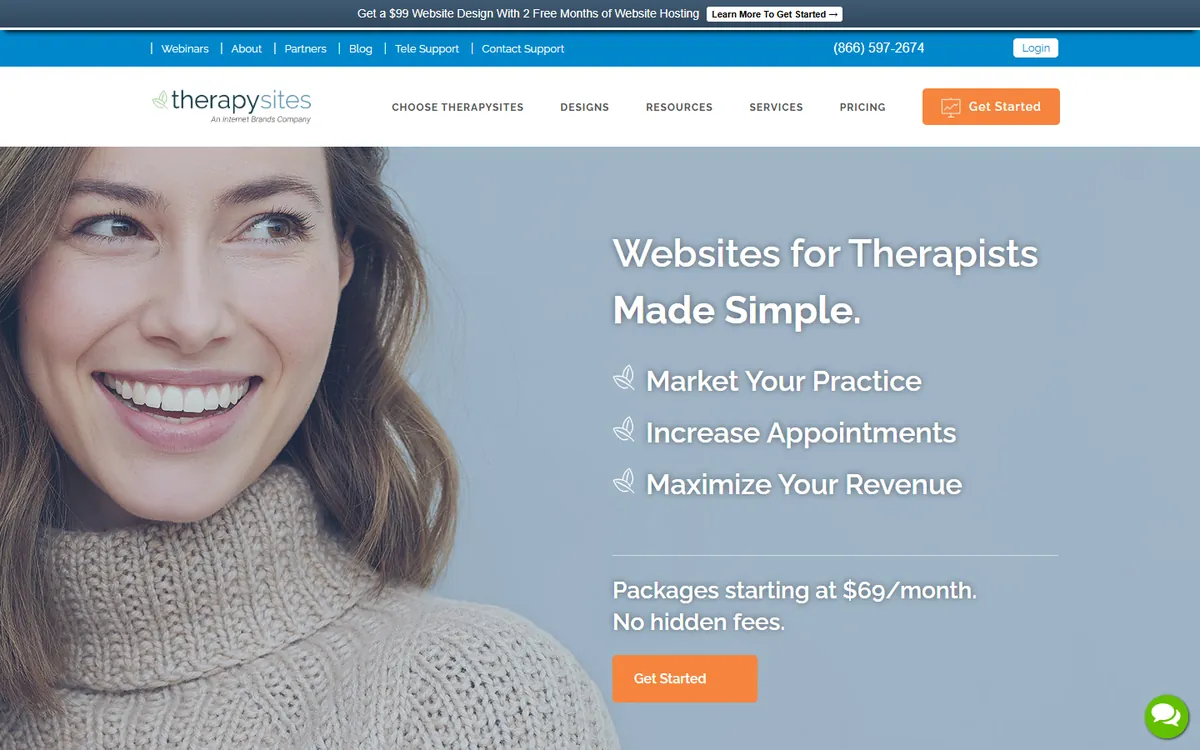
Cost: packages starting at $69/month, according to its homepage. Optional onboarding and add-ons such as SEO and secure email cost extra, and promotions on the design fee change often.
TherapySites is the closest direct alternative: a therapist-specific template website with hosting and support included, at a lower starting price. It also sells add-on services like SEO, reputation management and social media.
Choose it only if you want something very similar to Brighter Vision at a lower price. If you are searching for Brighter Vision alternatives because the template model is not working for you, you probably need something different. Watch out for the same trade-offs as any template platform: shared designs, limited customization, and a monthly fee that never ends.
EmpathySites is another therapist-specific service, but it costs more: its design package starts at $1,499 plus $97/month, and the design is licensed to you only while you stay on the platform.
2. SimplePractice Website Builder
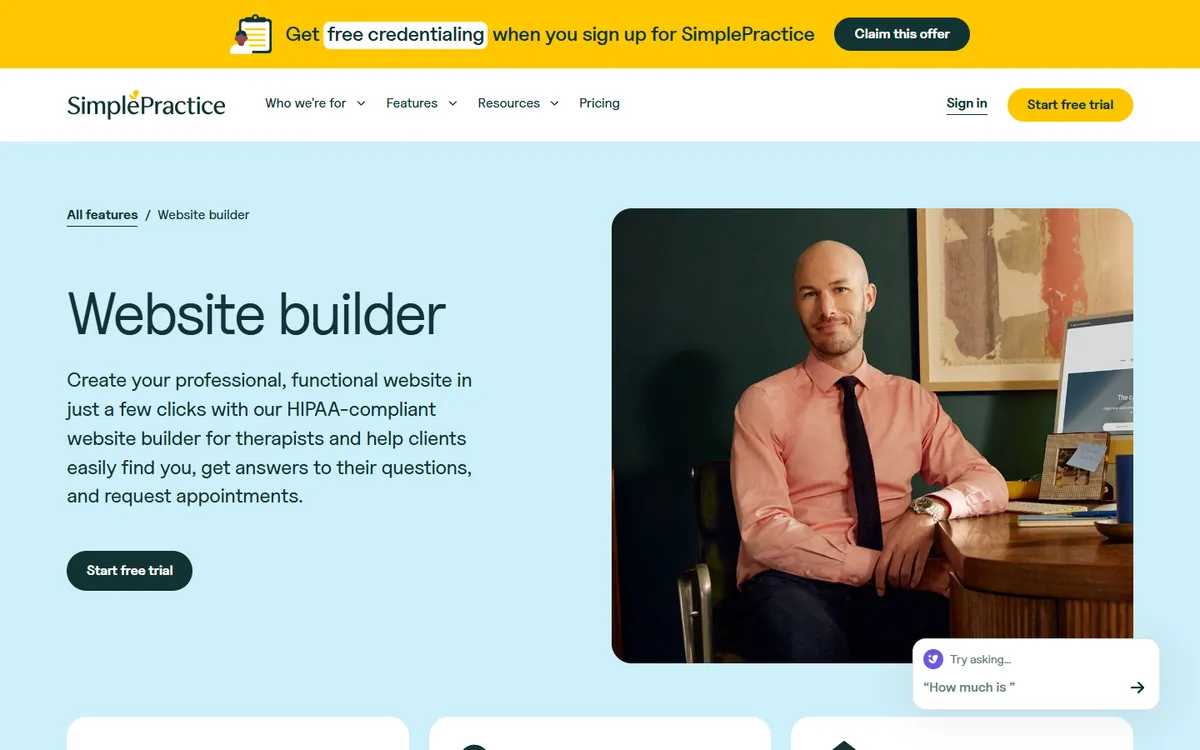
Cost: included with SimplePractice plans, which run $49, $79 or $99 per month for an individual clinician.
If you already use SimplePractice for scheduling, notes and billing, its website builder is already included in your plan. SimplePractice describes it as a HIPAA-compliant website builder, and it connects directly to online booking and your client portal.
Keep in mind: it offers limited design options and very little control over SEO, which makes it hard to rank for competitive searches like “anxiety therapist in [your city].” You cannot build out separate pages for each service or location the way a growing practice needs.
3. Squarespace
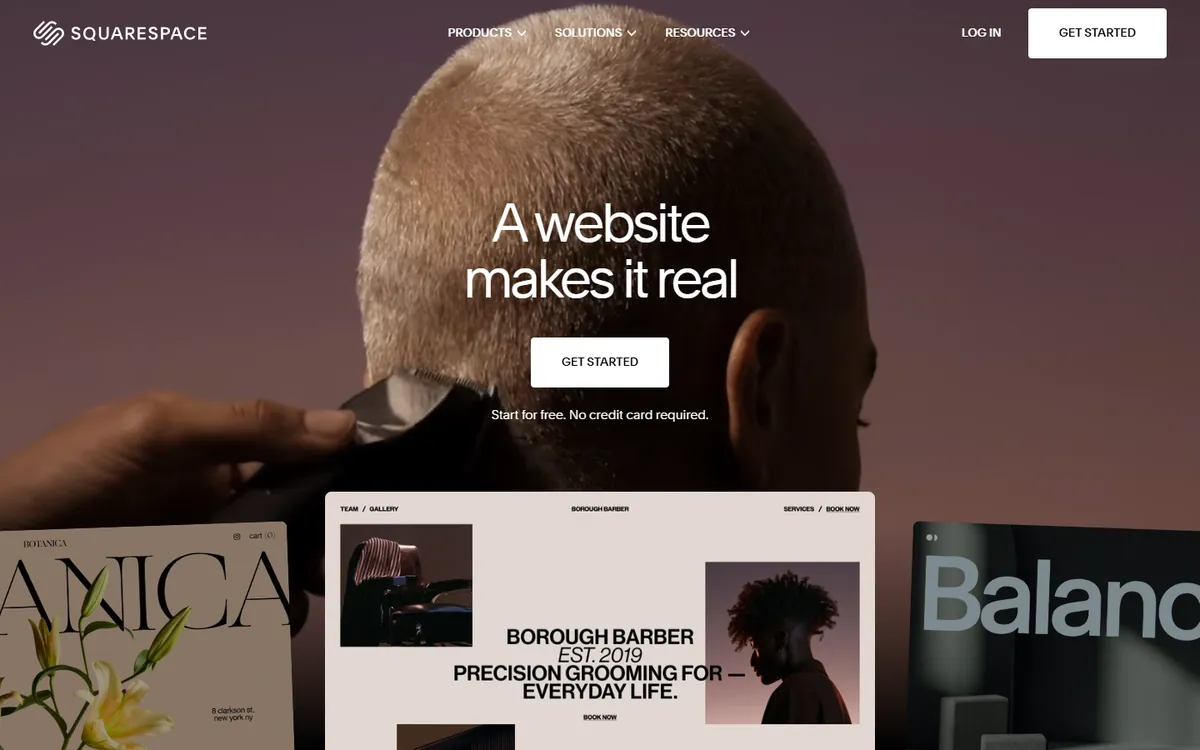
Cost: roughly $15 to $40 per month for the plans most practices need, with lower prices when billed annually. Prices vary by region.
Squarespace has some of the most attractive templates of any DIY builder, and it is easy to keep a small site looking clean. But the subscription buys software, not a finished marketing website. You still decide which pages to create, write the content, choose images, set up forms and handle SEO. It is possible to build an excellent Squarespace therapist website. It is equally possible to spend three weekends moving text boxes around and launch a site that never explains why someone should contact you.
Choose it if you have an eye for design and the time to write and update your own pages. Watch out for HIPAA: Squarespace’s standard forms are not set up for protected health information. Keep clinical details off your site’s forms, and use a HIPAA-compliant form tool or your practice management client portal instead.
4. Wix

Cost: roughly $17 to $40 per month for most business plans, billed annually. Prices vary by region and are confirmed at checkout.
Wix offers a drag-and-drop editor, a large app market and built-in tools for booking and email marketing. It gives you more freedom than Squarespace, which can be a benefit or a trap: it is easy to end up with inconsistent spacing, weak mobile layouts and pages that look different from one another.
Choose it if you want a flexible DIY builder with lots of add-ons. Watch out for the same HIPAA limits as Squarespace, and for sites that become cluttered and slow as apps are added.
5. WordPress You Build Yourself
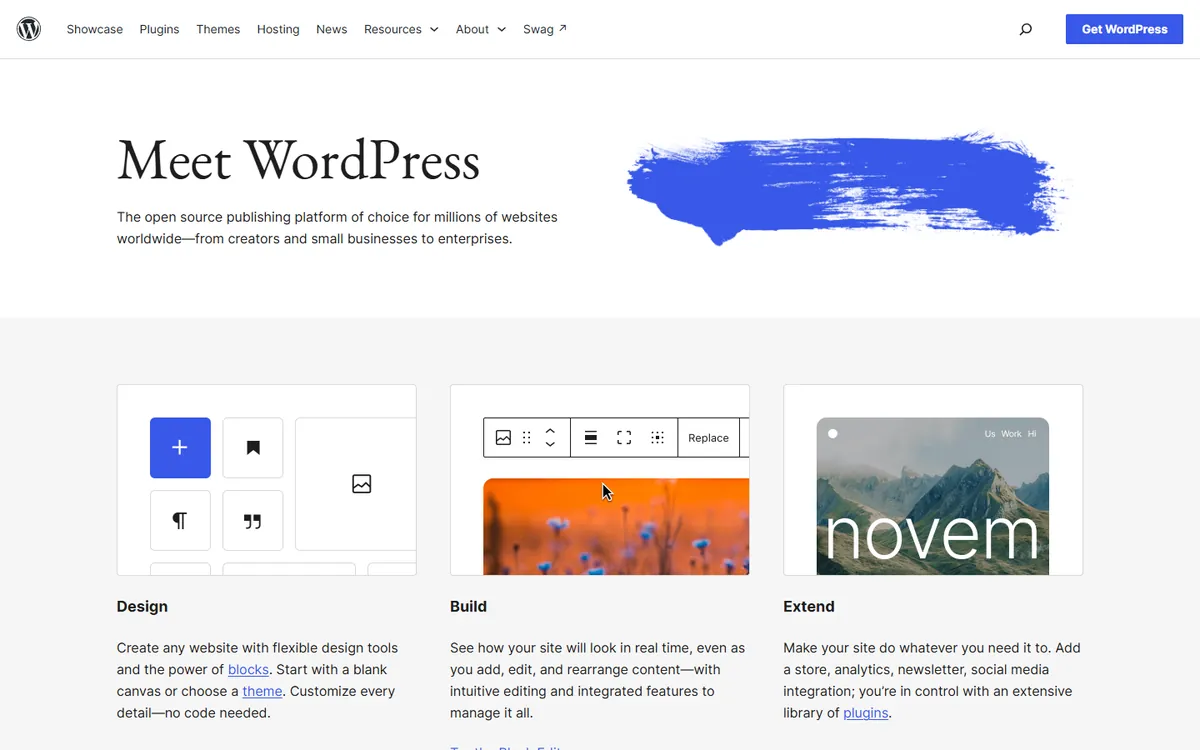
Cost: the WordPress software is free. Expect to pay for hosting (often $10 to $30 per month), a domain, and possibly a premium theme or plugins.
WordPress powers a large share of the web, and a self-hosted WordPress site is fully yours: you can move it to any host, hire any developer and control every part of the SEO.
Choose it if you are technical, or have someone who is. Watch out for maintenance. Updates, backups, security and speed are your responsibility, and a neglected WordPress site is a common source of problems.
6. AI Website Builders
Cost: often around $10 to $30 per month, and some offer free plans.
AI website builders create a whole site in a few minutes from a handful of answers about your practice. That speed is the appeal, and it is also the problem. Every site is generated from the same patterns, so they all look and read the same, with generic copy that could describe any therapist in any city.
They also do very little for SEO. There is usually no keyword research, no service pages planned around what clients actually search for, and limited control over page structure. In our experience, these sites are close to invisible on Google, so they rarely bring in new clients on their own.
Choose it if you only need a temporary placeholder while you plan a proper website. Watch out for paying every month for a website nobody finds. AI builders are cheap, but for a practice that wants new clients they are probably the worst option on this list.
7. A Custom WordPress Website Built for Your Practice
Cost: agencies often charge $2,200 to $4,500 for a solo practice, and more for group practices, plus hosting and ongoing care.
With J Curve: we build custom WordPress websites for therapists for a one-time fee of $397, or include the website with our Google Ads management. When the site is finished, we give you the WordPress administrator login and the other credentials you need to control it. The website and domain are yours to keep forever, and you do not have to keep paying us to stop it from disappearing.
A custom website is designed around your practice: your specialties, your ideal clients, your city and how you want people to contact you. It can have a dedicated page for every service and location, its own landing pages for Google Ads, and proper tracking, all structured from the start to rank on Google and turn visitors into consultations.
After launch, you can manage the website yourself, hire someone else later, or keep us involved for updates, new content, maintenance and SEO. The website stays yours either way.
Choose it if you want your website to be a main source of new clients rather than an online brochure. Watch out for designers who do not understand therapy practices, HIPAA or SEO. “Custom WordPress” can mean a site built around your goals, or a cheap theme with your logo swapped in. Ask to see examples and results from other practices.
Case study
What a custom website can do for a practice: after we rebuilt Coastal Virginia Mental Health’s website and paired it with Google Ads and SEO, the practice got 206 new client leads from Google Ads in six months, and its keywords on Google’s first page grew from 2 to 22.
For inspiration, see our list of the best therapist website examples, or our website design service for therapists.
What Five Years Actually Costs
Monthly prices look small, so it helps to compare them over the life of a website. These are rough estimates for a solo practice, before add-ons:
| Option | Approximate five-year cost |
|---|---|
| Brighter Vision Start (annual billing) | About $4,800 |
| Brighter Vision Flourish (annual billing) | About $17,900 |
| TherapySites (from $69/month) | About $4,100 and up |
| Squarespace or Wix | About $1,000 to $2,400, plus your time |
| AI website builder | About $600 to $1,800, for a site that is rarely found on Google |
| Custom WordPress website from J Curve | $397 one time, and you keep it forever |
Our recommendation
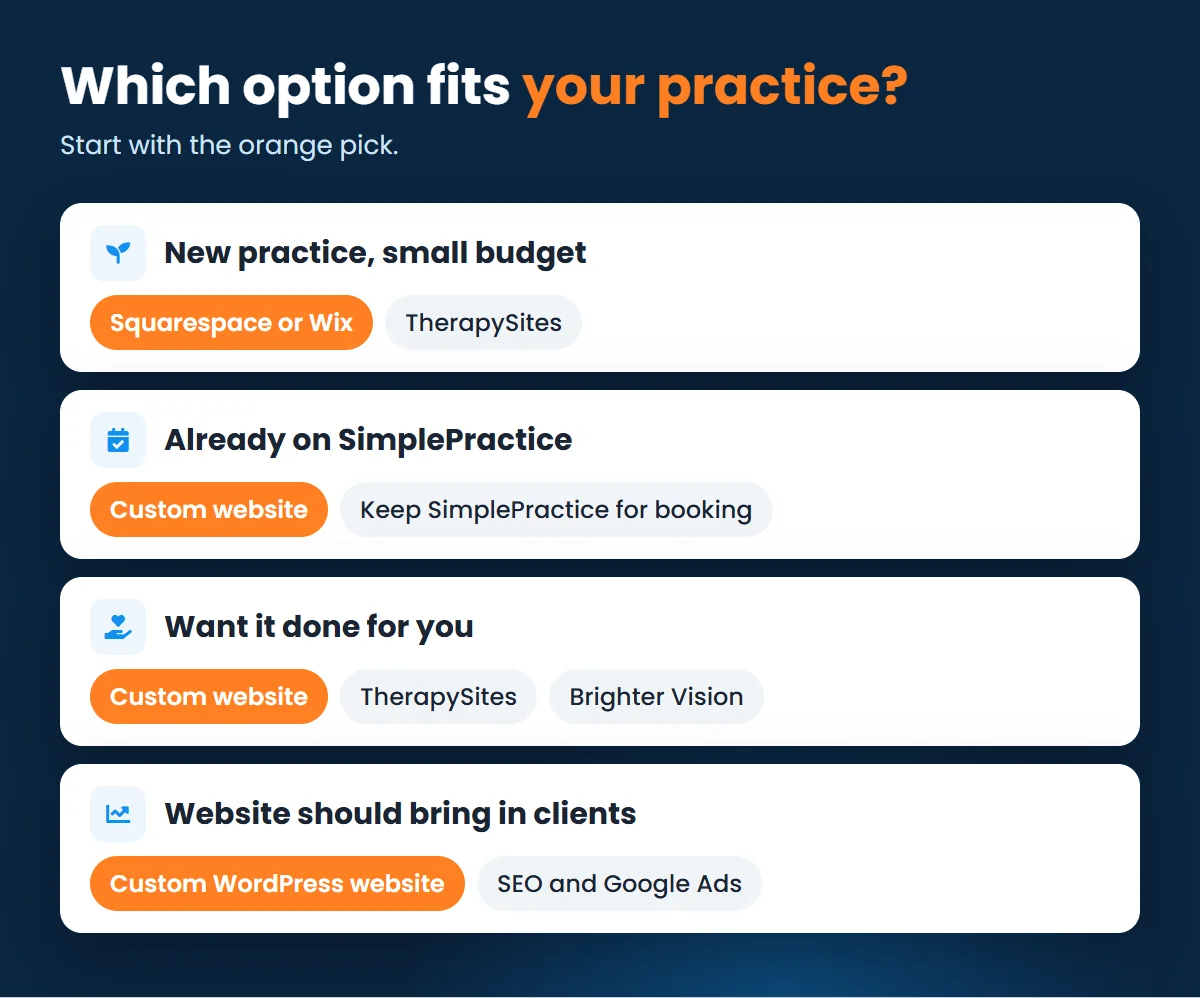
We recommend a custom WordPress website designed for your practice. It is yours to keep, it is built around your specialties, your ideal clients and your city, and it can be set up from day one to rank on Google and turn visitors into consultations. J Curve builds one for a one-time fee of $397, or includes it with our Google Ads management.
When It Makes Sense to Leave Brighter Vision
Switching usually makes sense when:
- Your website looks too similar to other practices
- You are paying every month but rarely use the support, or it takes too long to get changes made
- Your site is not bringing in new clients
- You need more service or location pages for SEO
- You want dedicated landing pages for Google Ads
- You want full control of tracking and integrations
- You want to own the complete website, not rent it
Do not switch just because another platform has a nicer template. A move takes effort, and the new website should solve a real problem the current one cannot.
Questions to Ask Before You Choose
- Who owns the domain, the design and the content if I leave?
- Can the website be exported, and what happens to it when the subscription ends?
- Is there a contract term, a setup fee or a cancellation fee, and does it renew automatically?
- Are the contact forms HIPAA-compliant, and will you sign a Business Associate Agreement (BAA) if needed?
- Can I edit pages myself, and how long do changes take when I need help?
- Can I control SEO basics: page titles, meta descriptions, headings, URLs and redirects?
- How fast is the site on a phone? Most people searching for a therapist are on mobile.
- Can you show me therapy practices like mine and the results their websites produce?
How to Switch Website Platforms Without Losing Your Google Rankings
Most of the damage when therapists change website providers comes from the move, not the new platform. If your current site ranks for anything, protect it:
- Get control of your domain first. Brighter Vision says it releases domains without a fee: you email support, and they send you a login and a transfer code. Start early, because a domain cannot be transferred within 60 days of purchase or of a change to its owner details. Remember that the domain is not the website: moving it does not move your pages, forms, files or email.
- Protect your email. If your practice email runs on the same domain, plan the change so it does not stop working during the move.
- Make a list of every page on your current site, including blog posts and images, before anything is cancelled. Note which pages bring in visitors in Google Search Console.
- Keep the same URLs where you can. Where a page moves, set up a 301 redirect from the old address to the closest matching new page. Do not send everything to the homepage: someone clicking an old “anxiety therapy” result should land on the new anxiety page.
- Move your content, not just the design. Pages that rank should keep their main topic, headings and depth.
- Keep your practice name, address and phone number identical to your Google Business Profile and directory listings.
- Reconnect tracking (Google Analytics, Search Console and any ad conversion tracking) before launch, so you can see whether inquiries hold steady.
- Test every contact path on the new site: submit every form, tap every phone number, test booking, and confirm the right person receives the inquiry.
- Update the links on your profiles, such as Psychology Today and other therapist directories, your Google Business Profile and your social profiles.
- Watch Search Console for a few weeks after launch and fix any “page not found” errors quickly.
Once the new site is live, a strong Google Business Profile and ongoing SEO for therapists help it grow from there.
A Better Website Should Do More Than Look Different
Changing platforms will not fix unclear messaging, thin service pages or weak calls to action on its own. The point of a therapist website is not to show that the practice has good taste in muted colors. It should help the right person quickly understand:
- This practice works with people like me.
- It offers the help I am looking for.
- Appointments are available where I live, or online.
- I feel comfortable taking the next step.
- I know exactly how to reach someone.
That is what makes a new website worth it.
Not Sure Which Option Is Right for Your Practice?
If you are paying for a website that is not bringing in clients, or you are planning to leave Brighter Vision and want to keep your rankings, schedule a free strategy session. We will look at your current site, what should be kept, and whether a new website would genuinely bring in more inquiries.
Frequently Asked Questions
Is Brighter Vision worth it for therapists?
In our experience, usually not as a long-term choice. The low starting price is attractive, but the website stays tied to the subscription, the designs are often generic, and over a few years the total cost is far higher than a website you own.
How much does Brighter Vision cost in 2026?
Brighter Vision’s Start plan is $99/month, or $78/month billed annually, plus a $100 setup fee. Grow is $179/month ($143 billed annually), and Flourish, which includes HIPAA-compliant forms, is $349/month ($299 billed annually). Its top plan is custom priced.
Do therapists own their Brighter Vision website?
Not in the way most people mean it. Brighter Vision says you own your domain and the content you provide, but the working website stays on its platform. When the service ends, the site comes down, and you have to rebuild it somewhere else.
What is the best alternative to Brighter Vision?
For most practices, a custom WordPress website you own. J Curve builds one for a one-time fee of $397, or includes it with our Google Ads management, and gives you the login so the site stays yours. TherapySites is the closest match only if you want something very similar to Brighter Vision.
Can I keep my domain if I leave Brighter Vision?
Yes. Brighter Vision says you fully own your domain and can have it released without a fee. Start the transfer before you cancel, and make sure the change does not interrupt your practice email.
Will switching website platforms hurt my SEO?
It does not have to. Rankings usually drop because old URLs disappear without redirects, content is removed, or tracking is lost. Keep your important pages, set up 301 redirects for anything that moves, and monitor Google Search Console after launch.
Is Squarespace or Wix better for a therapist?
Squarespace suits therapists who want polished design with more guardrails. Wix offers more freedom, which also makes messy layouts easier to create. With both, you or someone you hire still has to plan and write the website.
Does a therapist website need to be HIPAA compliant?
Any part of your website that collects protected health information, such as intake forms or messages about symptoms, should use a HIPAA-compliant service with a signed BAA. A simple contact form that only asks for a name, email and phone number carries less risk, but it is safest to avoid collecting clinical details on standard website forms.
What is the cheapest way to get a therapist website?
A DIY builder such as Squarespace or Wix has the lowest monthly price. Over several years, a $397 one-time custom website from J Curve often costs less, because there is no monthly platform fee.
Sources
- Brighter Vision: Pricing
- Brighter Vision: Terms of Service
- Brighter Vision: Transferring Domains Away From Brighter Vision
- Better Business Bureau: Brighter Vision Customer Reviews
- Better Business Bureau: Brighter Vision Complaints
- Kristie Plantinga: My Honest Thoughts on Brighter Vision
- TherapySites: Homepage and Packages
- EmpathySites: Pricing
- SimplePractice: Pricing
- Squarespace: Pricing
- Wix: Plans and Pricing
- Project Cost Estimator: Therapist Website Cost in 2026
Prices and public plan details last checked November 2026. J Curve Advertising builds custom websites for therapists and is one of the options described here.