

You became a therapist to help people, not to spend half your week wondering what to post on Instagram, rewriting your Psychology Today profile, or checking whether anyone filled out the contact form on your website.
But private practice comes with an uncomfortable reality:
Being a good therapist and having a full caseload are two different things.
You can be excellent at what you do and still struggle to attract enough of the right clients.
And when your schedule isn’t full, the natural reaction is usually to try more marketing.
Post more.
Create another directory profile.
Ask for more referrals.
Redesign the website.
Try Facebook.
Write blogs.
Boost a post.
Run an ad.
The problem is that doing more marketing doesn’t necessarily create more clients.
What matters is building a simple system that helps the right person:
- Find you when they need help.
- Quickly recognize that you may be a good fit.
- Trust you enough to reach out.
- Easily take the next step.
- Receive a fast, helpful response when they do.
After working on marketing, websites, advertising, and lead-generation systems for therapy practices, we’ve repeatedly seen the same pattern:
The practices that grow consistently usually aren’t marketing everywhere. They are making a few important channels work together.
Here is how to do that.
Web hosting is a service that allows you to publish your website on the internet. In basic terms, it’s where your website “lives.”
Just like you store photos and documents on your computer or in cloud storage, websites need a place to store their files, images, code, and content. A web host provides that space on a powerful computer (called a server) that’s always connected to the internet. This way, when someone types in your domain name (like www.example.com), they’re taken to your website hosted on that server.
1. Stop Marketing to “Everyone Who Needs Therapy”
One of the fastest ways to make therapist marketing weaker is trying to appeal to everybody.
Consider these two messages.
Option A:
Compassionate therapy to help you live your best life.
And:
Option B:
You don’t have to keep spending every Sunday night dreading Monday. Therapy for professionals struggling with anxiety, burnout, and the feeling that they can never switch off.
The first technically applies to more people.
The second will probably mean far more to the person it is intended for.
Your potential client is rarely asking:
“Which therapist has the broadest possible range of clinical capabilities?”
They’re thinking:
“Does this person understand what I’m dealing with?”
Your marketing should answer that question.
This doesn’t necessarily mean limiting your practice to one diagnosis forever. It means deciding which people you especially want to reach and making it easy for those people to recognize themselves.
Instead of:
- Anxiety
- Depression
- Trauma
- Couples
- Teens
- Adults
- Stress
- Life transitions
think in terms of the actual person on the other side of the screen.
For example:
- High-achieving professionals whose anxiety is becoming exhausting
- Couples who keep having the same argument and don’t know how to stop
- Parents worried that their teenager is becoming increasingly withdrawn
- Adults who understand their trauma intellectually but still feel controlled by it
- Men who know something needs to change but hate the idea of “going to therapy”
The more clearly someone recognizes themselves, the easier the next step becomes.
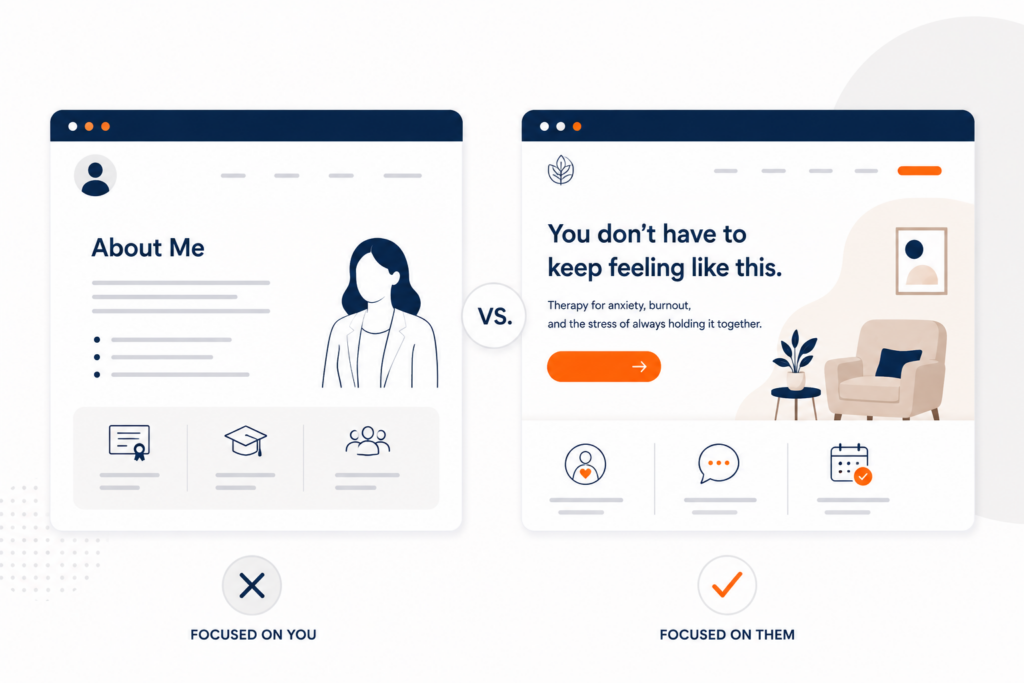
3. Don’t Make Your Website About You
This sounds strange because technically it is your website.
But the person visiting it probably isn’t thinking much about you yet.
They’re thinking about themselves.
They may be wondering:
- Is what I’m experiencing serious enough for therapy?
- Will this therapist understand me?
- Am I going to feel judged?
- What happens if I contact them?
- Can they actually help with this?
- How much will it cost?
- Do they have availability?
- Is therapy really what I should do next?
Yet many therapist websites open with several paragraphs about credentials, training, modalities, professional philosophy, and certifications.
Those things can matter.
They just shouldn’t always come first.
Your website’s first job is to make the visitor feel:
“This seems like the right place for what I’m dealing with.”
Then you can reinforce that decision with your credentials and experience.
A strong therapy website should quickly communicate:
Who you help
Not merely “individuals, couples and families,” but who those people are and what they are struggling with.
What you help with
Use the language potential clients use, not only clinical terminology.
Why someone might choose you
Your experience, specialization, approach, location, availability, telehealth options, or another meaningful differentiator.
What they should do next
Call.
Schedule a consultation.
Request an appointment.
Check availability.
Whatever the next step is, don’t make people hunt for it.
If you want to see what this looks like in practice, you can take a look at some of the therapy websites we’ve built for examples of websites designed to make services clear, build trust, and make it easy for potential clients to reach out.
5. Make Google Business Profile Part of Your Strategy
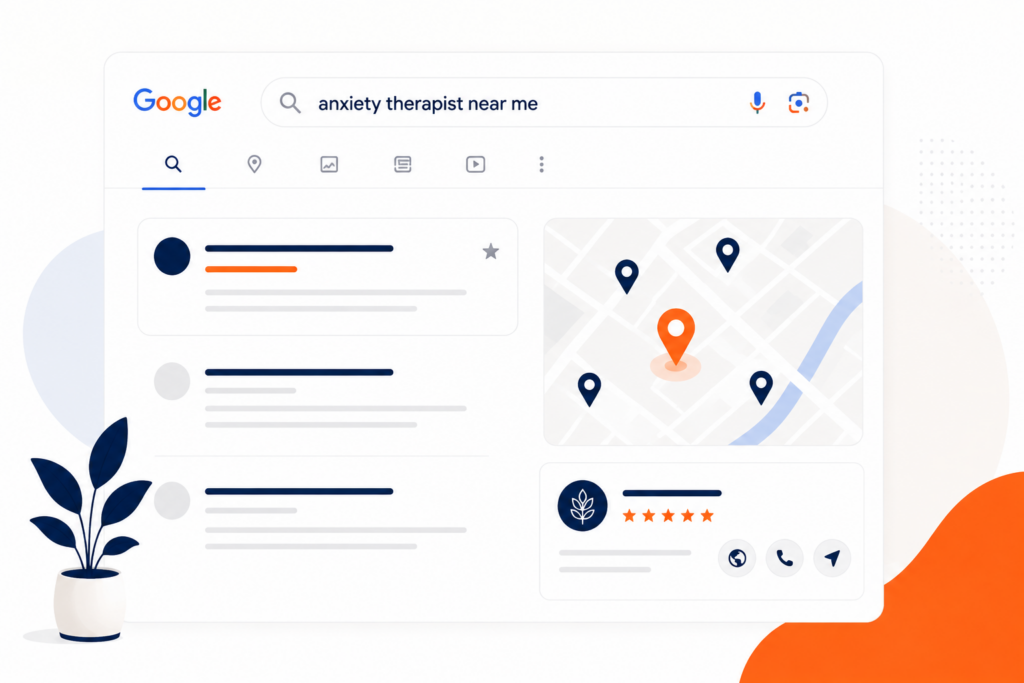
For locally based practices, your Google Business Profile can become one of your most valuable online assets.
People searching for nearby services often encounter map results before they ever reach traditional organic website listings.
Make sure the information on your profile is accurate and complete, including:
- Practice name
- Address where applicable
- Phone number
- Website
- Business category
- Hours
- Services
- Photos
- Practice description
Google recommends maintaining complete and accurate business information to improve your chances of appearing for relevant local searches.
Your profile should also connect naturally with the rest of your online presence.
If Google sees a therapy practice on your Business Profile but the website barely explains where you practice, what you specialize in, or whom you serve, you’re making Google’s job harder.
Consistency matters.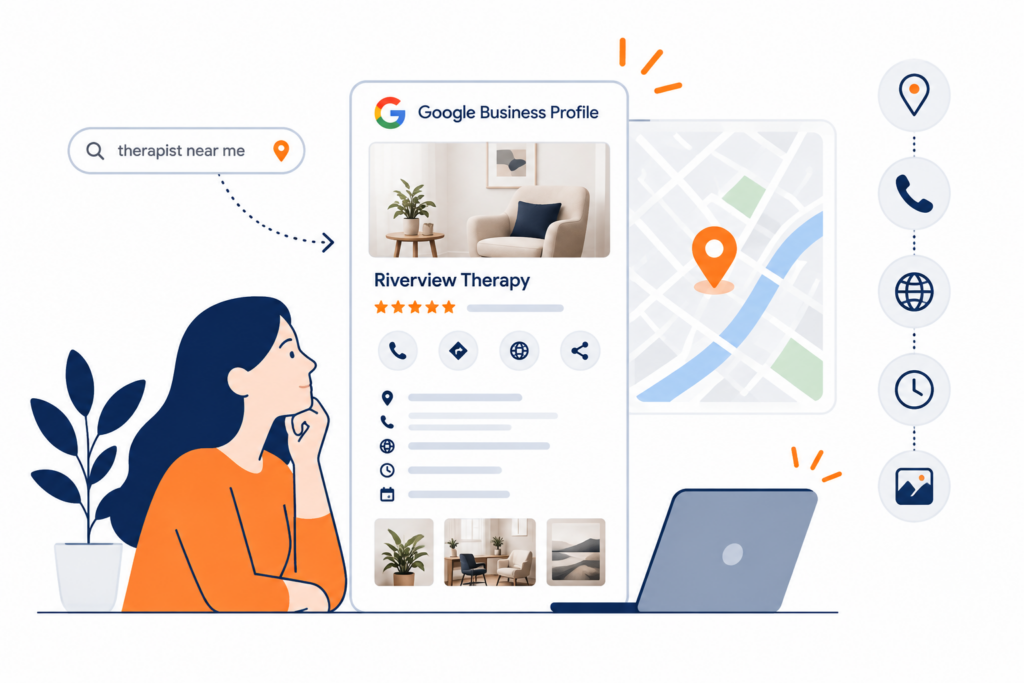
8. Stop Judging Marketing by Clicks
This is one of the most important lessons in private-practice marketing.
A click is not a client.
Neither is:
- An impression
- A website visitor
- A Facebook like
- An Instagram follower
- A high click-through rate
- A form submission
Ultimately, you care about something much closer to:
How many appropriate new clients did this marketing produce?
Imagine two campaigns.
Campaign A
1,000 website visitors
25 inquiries
3 new clients
Campaign B
250 website visitors
18 inquiries
10 new clients
Which campaign would you rather have?
Traffic without conversion can make a marketing report look impressive while your schedule remains empty.
Track the entire process:
Search → Click → Inquiry → Contact → Consultation → Scheduled Appointment → Client
This is also why we emphasize lead tracking and follow-up in our social media marketing and lead-generation systems.
Knowing where inquiries came from allows you to invest more in what works and stop paying for what doesn’t. 
11. Use Social Media for Trust, Not Just Reach
Many therapists feel pressure to become content creators.
You don’t necessarily need 100,000 followers.
You need potential clients to understand who you help and feel comfortable taking the next step.
Instead of constantly asking:
“What should I post today?”
ask:
“What might someone need to hear before they feel comfortable contacting a therapist?”
That can produce much stronger content.
Topics might include:
- Signs couples often notice before seeking counseling
- Why high-functioning anxiety can still be exhausting
- What happens during the first therapy appointment
- What someone should know before trying EMDR
- When a parent might consider speaking with a therapist about their teenager
- Why waiting until a relationship is “bad enough” can make getting help harder
- What private-pay therapy allows someone to consider when choosing a therapist
Social media can familiarize someone with you before they’re ready to contact you.
But don’t confuse attention with appointments.
If you’re spending hours each week producing content and it isn’t contributing to inquiries, referrals, email subscribers, website traffic, or another meaningful business goal, reconsider how much of your time it deserves.
The American Counseling Association also recommends that counselors think carefully about professional boundaries, confidentiality, and ethical obligations when using social media. Their ethics resources for counselors are available here. 
14. Don’t Ask Every Marketing Channel to Do the Same Job
Different channels work at different stages.
Google Search
Captures existing demand.
Someone already wants a therapist.
SEO
Builds long-term visibility for searches related to your services.
Google Business Profile
Helps local clients discover your practice.
Psychology Today and directories
Put you in front of people actively browsing therapists.
Social media
Builds awareness and familiarity.
Keeps relationships alive over time.
Referral marketing
Builds trusted professional recommendation channels.
Paid social advertising
Can create awareness and generate interest, but functions differently from someone actively searching Google for a therapist.
This distinction matters.
If a Facebook campaign doesn’t behave exactly like Google Search, that doesn’t automatically mean Facebook is broken.
They’re reaching people in different contexts.
Choose channels according to the job you want them to perform.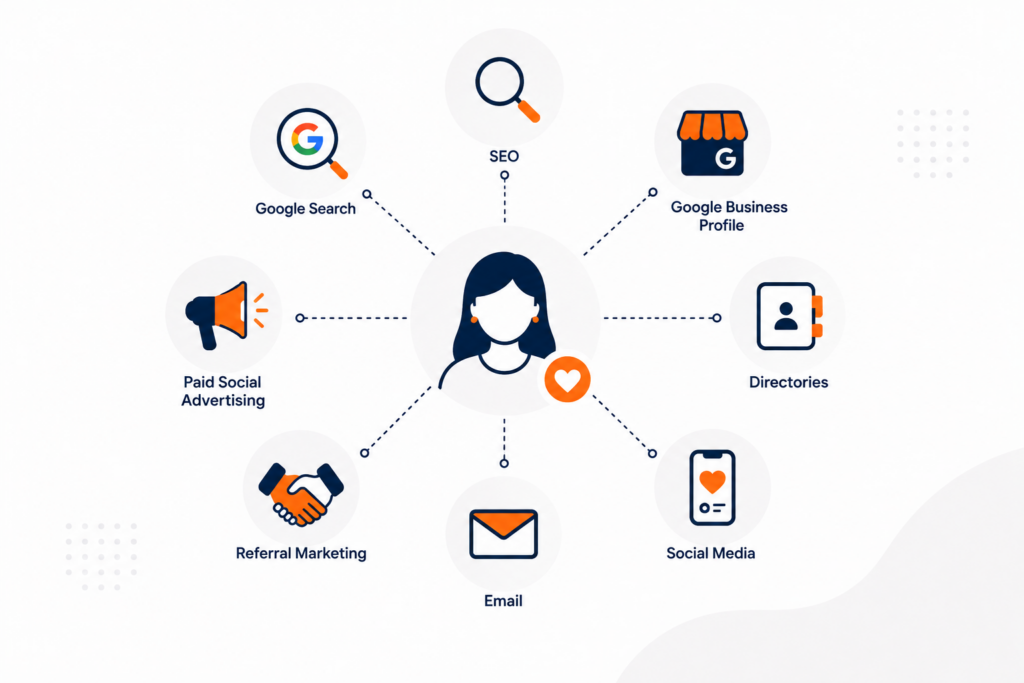
What Usually Doesn’t Work Well for Therapists
There are exceptions to everything in marketing, but these are some patterns worth watching.
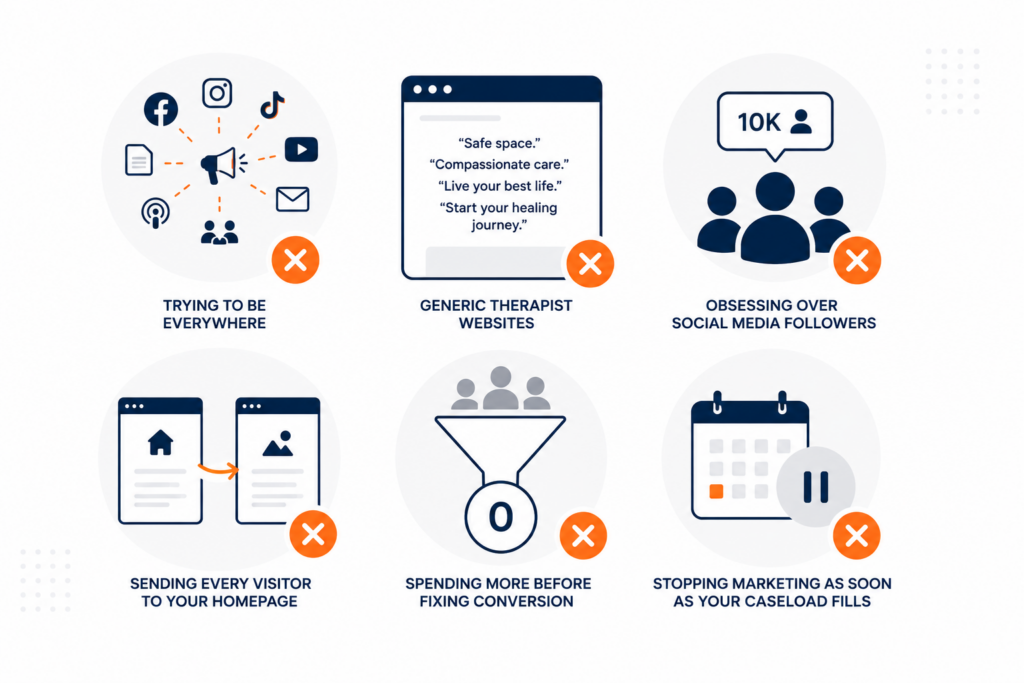
Trying to Be Everywhere
You don’t need seven social platforms, weekly blogs, daily Reels, Google Ads, Facebook Ads, newsletters, YouTube, TikTok, networking events, three directories, and a podcast simultaneously.
Get one or two acquisition channels working.
Then expand.
Generic Therapist Websites
If your homepage could belong to 5,000 other therapists after changing the logo and headshot, it isn’t doing enough differentiation.
“Safe space.”
“Compassionate care.”
“Live your best life.”
“Start your healing journey.”
These aren’t necessarily bad phrases.
They’re simply so common that they rarely give someone a specific reason to choose you.
Show people that you understand their particular problem.
If you’d like some concrete examples, you can browse websites we’ve built for therapy and mental-health practices and look at how the messaging, page structure, calls to action, and service pages are handled.
Obsessing Over Social Media Followers
Ten thousand followers who will never become clients aren’t necessarily more useful than 200 local people who trust your practice and understand what you do.
Reach is a means.
Not the goal.
Sending Every Visitor to Your Homepage
An anxiety search should lead to anxiety content.
A couples search should lead to couples content.
A trauma ad should lead to trauma content.
Match the message to the intent.
Spending More Before Fixing Conversion
If 100 people visit your site and nobody contacts you, the first question shouldn’t always be:
“How can we get 200 visitors?”
Ask:
“Why aren’t the first 100 contacting us?”
Sometimes the answer is traffic quality.
Sometimes it’s the website.
Sometimes it’s the offer.
Sometimes it’s trust.
Sometimes it’s the intake process.
Sometimes it’s all four.
Stopping Marketing as Soon as Your Caseload Fills
This is another common trap.
The practice gets busy.
Marketing stops.
Several clients graduate or reduce frequency.
Suddenly the caseload has openings.
Then marketing starts again from zero.
A healthier approach is building a consistent pipeline, then adjusting your investment according to capacity.
You don’t necessarily want unlimited leads.
You want predictable demand.