


Having openings in your schedule can be frustrating, especially when you know you provide good care.
The problem is usually not that people do not need therapy.
The problem is that the right people are not finding you, are not choosing you, or are not taking the next step once they land on your website.
If you want to get more therapy clients, the goal is not to market everywhere.
The goal is to build a simple system that helps potential clients find you, understand how you can help, and feel comfortable reaching out.
Here are nine ways to do that.
1. Make Sure People Can Find You on Google
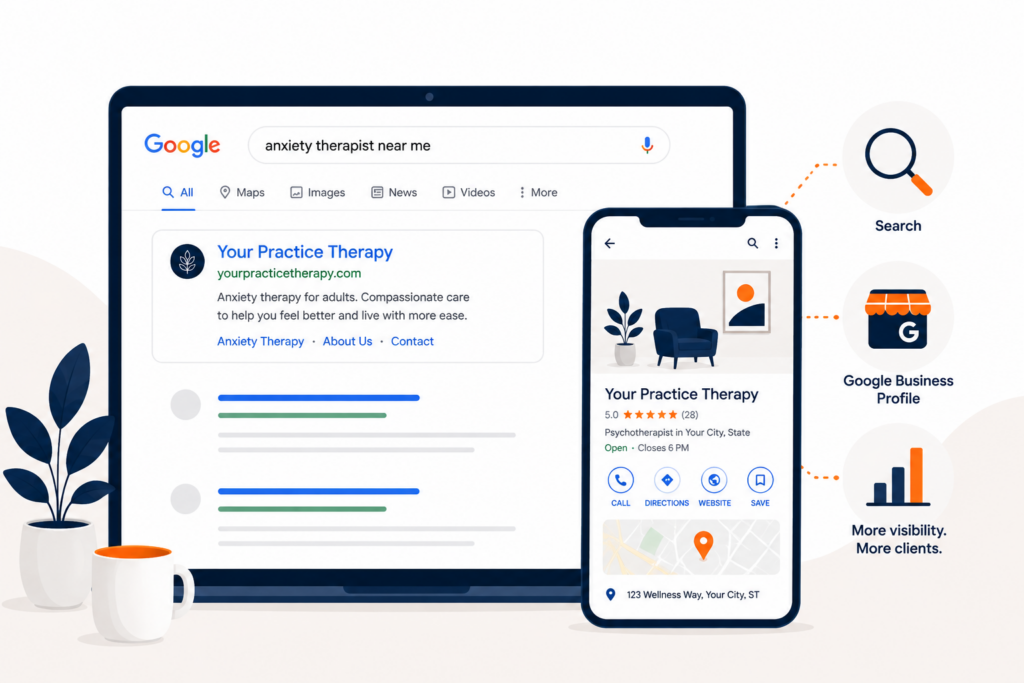
For most private practices, Google is one of the most important places to be visible.
Someone searching:
- anxiety therapist near me
- couples counseling near me
- trauma therapist
- therapist for teens
- EMDR therapist near me
is already looking for help.
That makes Google very different from social media, where you are usually trying to get someone’s attention before they have decided they need a therapist.
Your website, Google Business Profile, SEO, and Google Ads should all work together to help you appear when someone is actively searching for the services you provide.
If you have openings but are not sure whether enough people can actually find you, schedule a free strategy session with J Curve Advertising. We can take a look at your current visibility and where the biggest opportunities may be.
2. Create a Separate Page for Each Important Service
One of the biggest mistakes therapy practices make is putting every service on one general page.
If you provide:
- anxiety therapy
- depression therapy
- trauma therapy
- couples counseling
- teen counseling
- EMDR
each major service should usually have its own page.
Someone searching for a trauma therapist should land on a page specifically about trauma therapy.
Someone looking for couples counseling should not have to search through your homepage to figure out whether you work with couples.
Dedicated service pages can also give Google a much clearer understanding of what your practice offers.
Most importantly, they give potential clients a page that feels relevant to exactly what they are looking for.
3. Stop Making Your Website Sound Like Every Other Therapist
A lot of therapy websites say some version of:
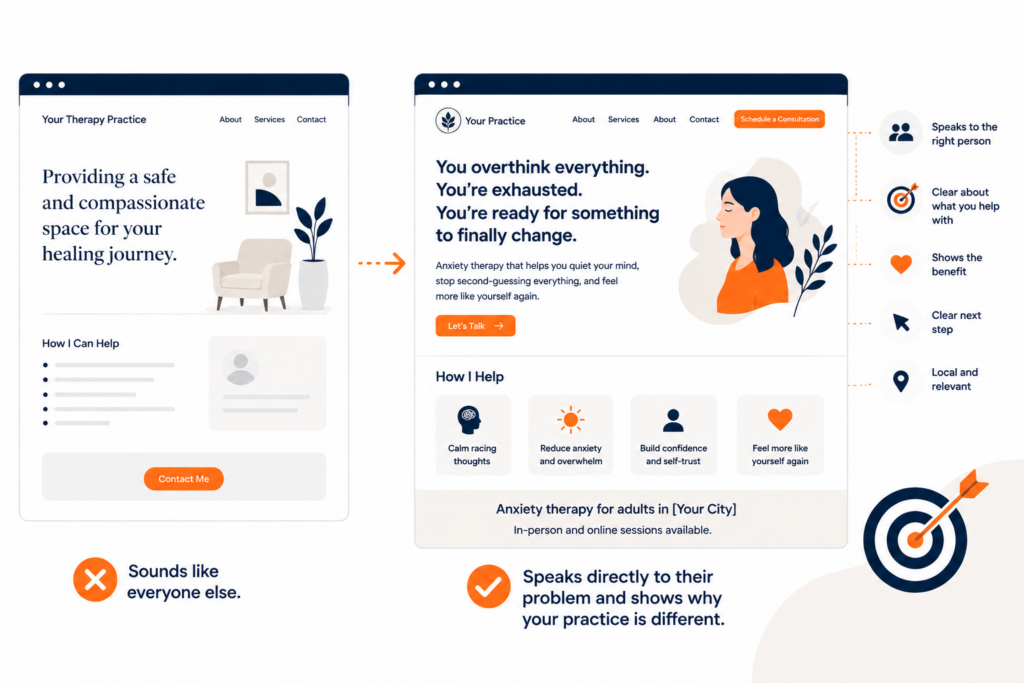
“Providing a safe and compassionate space where you can begin your healing journey.”
There is nothing wrong with that message.
The problem is that thousands of therapists say something very similar.
Your website should help someone recognize why your practice may be right for them.
For example:
Instead of simply saying:
Therapy for anxiety
you might say:
You may look like you have everything together, but your mind never seems to switch off. Therapy can help you stop feeling like you’re constantly waiting for something to go wrong.
The second version gives someone a much stronger reason to keep reading.
Potential clients should quickly understand:
- who you help
- what you help with
- why they might choose you
- what they should do next
If you want examples of therapy websites built around clearer messaging and conversion, you can also view websites we’ve built for therapists and mental health practices.
4. Use Google Ads When You Need Clients Faster
SEO can be extremely valuable, but it often takes time.
Google Ads can help you appear much sooner when someone searches for therapy.
But simply turning on an ad campaign is not enough.
The search, ad, and landing page should all match.
For example:
Search: couples counselor near me
Ad: Couples Counseling in [City]
Landing page: Couples Counseling
That is much stronger than sending every person who clicks an ad to the same generic homepage.
You also need to separate searches that suggest someone is ready to find a therapist from searches that are mostly informational.
Someone searching:
“anxiety therapist near me”
is usually much more valuable than someone searching:
“what is anxiety therapy”
The difference can have a major impact on whether your advertising produces clients or simply produces clicks.
You can learn more about our Google Ads management for therapists.
Or, if you’re wondering whether Google Ads would even make sense for your practice, schedule a free 30-minute strategy session. We can look at your practice, services, location, and current marketing before you decide what to do next.
5. Do Not Depend Entirely on Psychology Today
Psychology Today can work.
Many therapists get clients from it.
The issue is relying on it as your only source of new business.
When someone finds you through a directory, they are often comparing you with many other therapists at the same time.
Similar credentials.
Similar specialties.
Similar photos.
Similar descriptions.
That makes it harder to stand out.
A healthier strategy is to use directories as one part of a broader system that includes:
- your own website
- Google search visibility
- Google Business Profile
- referrals
- SEO
- paid advertising
- content
You want multiple ways for someone to discover your practice.

6. Fix Your Website Before Paying for More Traffic
If your website gets visitors but very few inquiries, getting more visitors might not solve the problem.
Imagine 100 people visit your site and only one contacts you.
You could spend more money trying to get 200 visitors.
Or you could ask why the original 99 people left.
Common issues include:
- confusing messaging
- no clear call to action
- weak service pages
- poor mobile experience
- too much clinical language
- no obvious pricing information
- no explanation of what happens after contacting you
- slow website speed
- little differentiation from competitors
Before increasing your advertising budget, make sure your website gives people a reason to take the next step.
If you are unsure whether your website is part of the problem, schedule a free strategy session. We can look at your current site together and identify where potential clients may be dropping off.
7. Respond to New Inquiries Quickly
Getting more leads will not help much if those leads disappear before scheduling.
Someone reaching out to a therapist may already feel nervous about making contact.
If they submit a form and hear nothing for a day or two, they may contact someone else.
Your intake process should make the next step easy.
That can include:
- immediate form confirmation
- fast notification to the person handling intake
- clear phone and email responses
- easy consultation scheduling
- appropriate follow-up
- clear information about availability and pricing
You do not need to pressure anyone.
You simply want to make it easy for someone who has already decided they want help to continue.

8. Track Clients, Not Just Leads
Marketing reports can look impressive while your schedule stays empty.
Clicks are not clients.
Website visitors are not clients.
Form submissions are not clients.
You should ideally know:
- where each inquiry came from
- how many inquiries became consultations
- how many consultations became clients
- which services generate the most clients
- which marketing channels produce the best clients
- how much it costs to acquire a new client
For example:
A campaign generating 30 leads may look better than one generating 15.
But if the first produces three clients and the second produces ten, the smaller campaign is doing far more for your practice.
This is why proper tracking matters.
9. Double Down on What Actually Produces Appointments
Therapists often feel like they need to do everything.
Instagram.
TikTok.
SEO.
Blogging.
Networking.
Google Ads.
Facebook Ads.
Psychology Today.
Email.
YouTube.
You probably do not need all of them.
Start by identifying one or two channels that reliably create conversations with potential clients.
Then improve those channels.
If Google is bringing in good clients, invest more there.
If referrals are working, develop more referral relationships.
If one service page consistently produces inquiries, build similar pages around your other specialties.
Your marketing becomes much easier once you stop asking:
“What else should I try?”
and start asking:
“What is already producing clients, and how do I get more of that?”

Why Some Therapy Practices Stay Half Full
A practice can have a good therapist, a nice website, and strong clinical experience and still struggle.
Usually, one part of the system is missing.
Maybe people cannot find the practice.
Maybe they find it but the website does not connect with them.
Maybe the website works but the intake process is too slow.
Maybe there are plenty of leads, but nobody knows which campaigns are actually producing clients.
That is why private practice marketing should be treated as a system rather than a collection of random tactics.
The strongest path usually looks something like:
Search → Website → Trust → Inquiry → Follow-Up → Appointment → Client
If one part is weak, the entire process becomes less effective
Want More Therapy Clients?
If your private practice has openings and you’re not sure what to fix first, you do not have to keep guessing.
We can look at your:
- website
- Google presence
- advertising
- service pages
- current lead sources
- competitors
- intake process
and help you identify where the biggest opportunity may be.
There is no need to try every marketing tactic at once.
The goal is to figure out what is most likely to help your practice attract the right clients consistently, then build around that.