

Google Ads for Therapists: Costs, Keywords & What Works

By Janko Jankovic10 min read
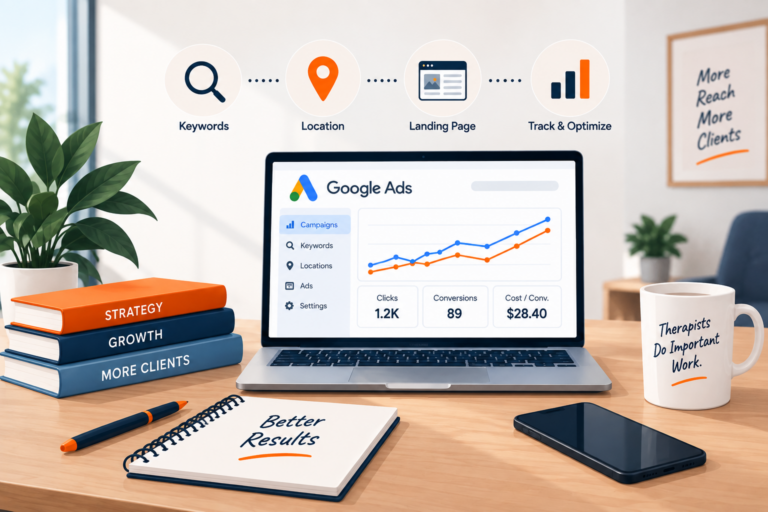
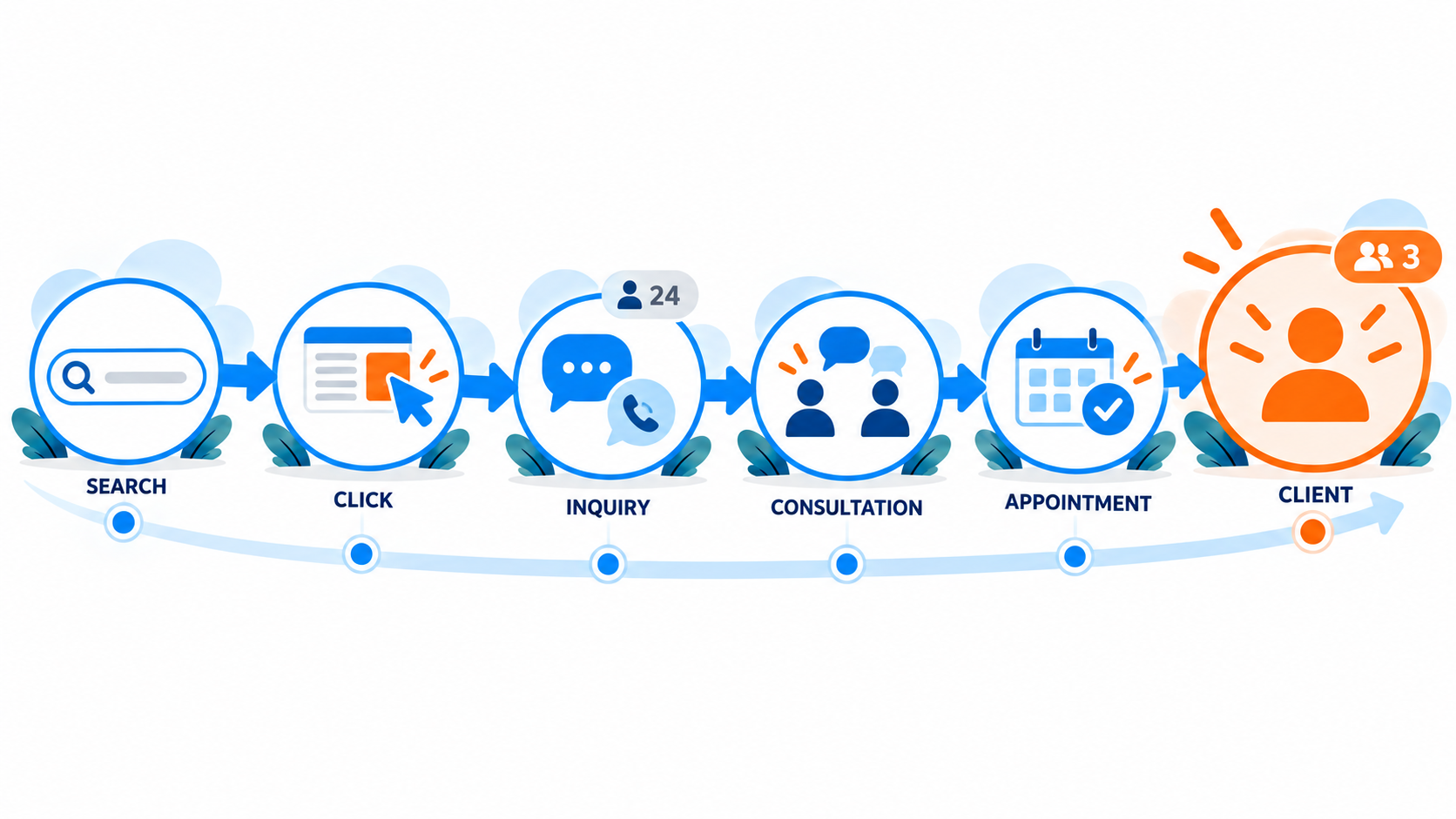
Illustration of a Google Ads funnel turning therapy searches into booked appointments

Google Ads can place a therapy practice in front of someone at the exact moment they are looking for help.

That is why the platform can work so well. It is also why mistakes get expensive quickly.

Someone searching for “anxiety therapist near me” or “couples counseling in Dallas” is much closer to contacting a therapist than someone scrolling through social media. But paying for that click does not guarantee they will choose the practice. The targeting, website, intake process, and follow-up all influence what happens next.

Campaign data across therapist, counseling, psychiatry, and TMS accounts shows both sides of Google Ads. Inquiries can arrive within the first few days, but campaigns can also spend hundreds of dollars on the wrong searches when targeting is left unchecked.

The campaigns that work usually share the same fundamentals:

  • They target people actively looking for the advertised service.
  • They keep locations, keywords, and budgets focused.
  • They send visitors to a page that matches the search.
  • They track real calls and completed forms.
  • They respond to inquiries quickly.
  • They measure scheduled and retained clients, not clicks alone.

This guide explains what therapists should know before investing in Google Ads and what tends to make the difference between expensive traffic and genuine client opportunities.

Do Google Ads Work for Therapists?

Yes, Google Ads can work for therapists when people are already searching for the type of help the practice provides.

Google Search is different from social media advertising. A social ad interrupts someone while they are doing something else. A search ad responds to an expressed need.

Compare these two situations:

  • Someone notices a therapy post while scrolling through Instagram.
  • Someone searches “trauma therapist accepting new clients.”

The second person has already moved closer to a decision. They are not being convinced that therapy exists. They are deciding whom to contact.

Google Ads is particularly useful for services with clear search demand, including anxiety therapy, couples counseling, trauma therapy, EMDR, child and teen counseling, family therapy, ADHD evaluations, medication management, and psychiatry.

It becomes less predictable when the service is unfamiliar or rarely searched. This is common with treatments such as TMS. Far more people search for depression treatment than for TMS because many people do not know TMS is an option. Those campaigns need to account for the broader patient journey rather than relying only on modality keywords.

How Much Should Therapists Spend on Google Ads?

There is no responsible universal budget. Cost depends on the city, specialty, competition, insurance status, and number of clients the practice can accept.

Focused therapy campaigns can begin at $10 to $20 per day, or approximately $300 to $600 per month. That can be enough in a smaller market or for one specific service. In a larger market, the same budget may collect data slowly or miss a large percentage of available searches.

A practice in Atlanta, New York, Los Angeles, or another competitive market should not expect the same costs as a practice in a smaller city.

The budget should answer three questions:

How expensive are the searches locally?

Use estimates for the actual city and services. National averages can be misleading because therapy keywords vary significantly by market.

How many new clients can the practice accept?

A solo therapist looking for three clients does not need the same campaign as a group practice with several clinicians and twenty openings.

What is an acceptable cost for a new client?

Cost per lead and cost per client are different.

Suppose a therapist charges $175 per session and the average new client attends 12 sessions. That represents approximately $2,100 in revenue before expenses.

If an inquiry costs $100 and one out of every three qualified inquiries becomes a client, the client-acquisition cost is approximately $300. Whether that is profitable depends on the practice, but it is more useful than asking whether a $10 click is expensive.

How Quickly Can Google Ads Generate Inquiries?

Ads can begin showing shortly after approval, but every market is different.

In recent campaigns, the first inquiry arrived after one day in one market and after six days in another. These are examples, not guarantees. Competitive locations, narrow specialties, weak landing pages, and limited budgets can all extend the timeline.

The first month should be treated as a controlled learning period. It reveals which searches produce relevant inquiries, which services have enough demand, whether the landing page encourages contact, and whether intake converts inquiries into appointments.

A campaign should not be declared successful because it generated two forms, or unsuccessful because the first week was quiet. Search quality, calls, consultations, appointments, and new clients need to be considered together.

The Best Google Ads Keywords for Therapists

Strong keywords usually combine a service with clear provider intent, a location, or both.

Examples include:

  • “anxiety therapist near me”
  • “couples counseling [city]”
  • “trauma therapist [city]”
  • “EMDR therapist near me”
  • “teen therapist [city]”
  • “online therapist in [state]”
  • “therapist accepting new clients”

These searches suggest that the person is looking for a provider, not simply researching a condition.

Broad informational searches such as “anxiety,” “trauma symptoms,” “free therapy worksheets,” or “psychology degree” often attract people who are not ready to contact a therapist. Some higher-consideration services require educational content, but a limited therapy budget should usually prioritize service-intent searches first.

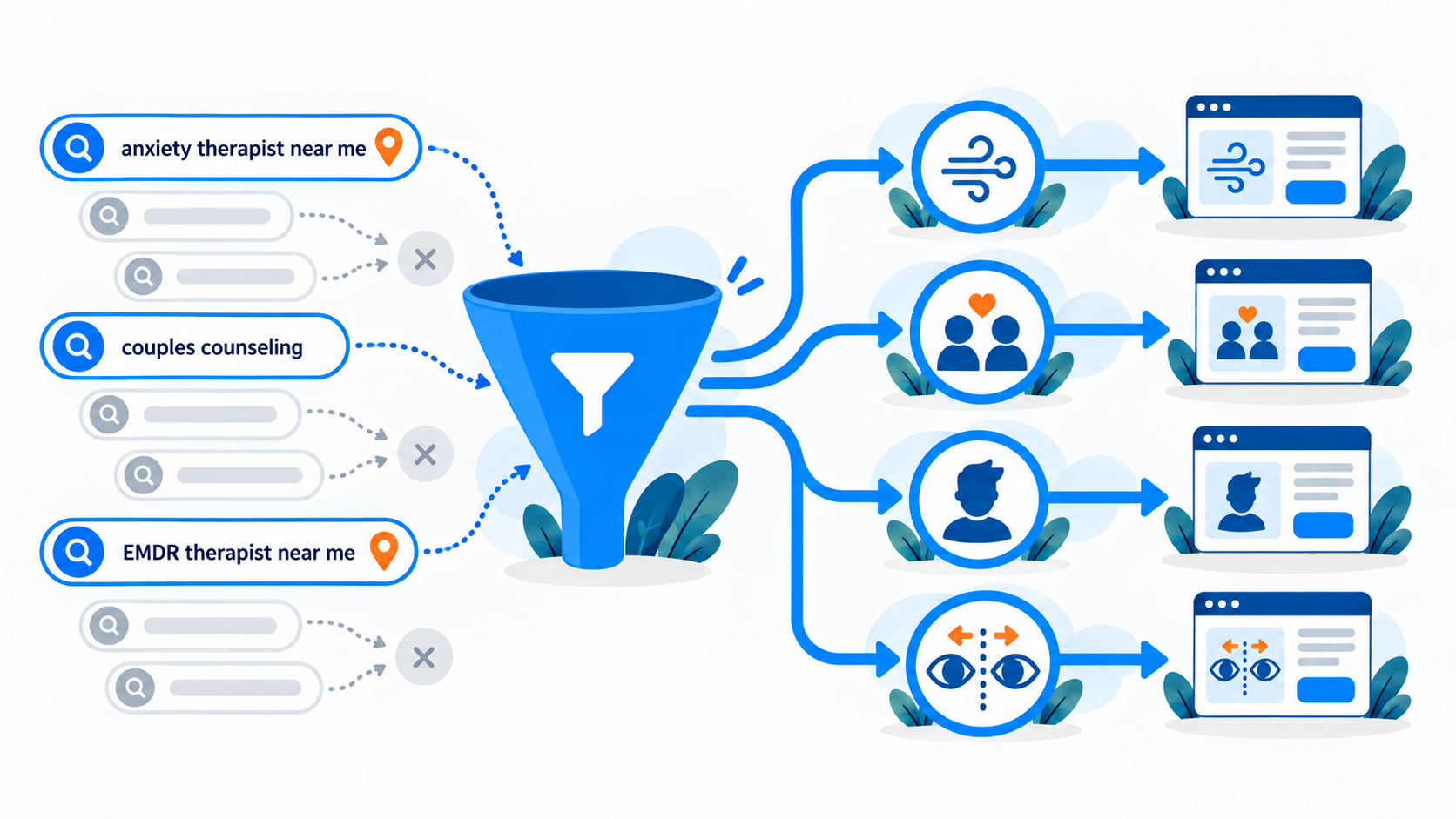
Keywords should also be separated by service. Anxiety therapy, couples counseling, teen therapy, and EMDR should not all sit inside one unfocused ad group. Each group should have ads and a destination page that match the subject.
Phrase Match, Exact Match, and Broad Match

Google offers broad, phrase, and exact keyword matching. Exact match gives the most steering, phrase match reaches more variations, and broad match can connect a campaign with much wider related searches. Google explains the current matching rules here.

New therapist campaigns with limited budgets usually benefit from beginning with phrase and exact match:

  • Exact: [anxiety therapist near me]
  • Phrase: “anxiety therapist”
  • Broad: anxiety therapist

Broad match is not automatically bad. It has worked in accounts where tracking was reliable, negatives were maintained, and irrelevant competitor traffic represented only a small portion of spend.

But in one competitive mental health campaign, lead costs rose above $600 when broad searches and service intent were not controlled tightly enough.

Broad match is easier to justify when:

  • Conversion tracking is accurate
  • The account has useful conversion data
  • The service and location are clear
  • Negative keywords are actively maintained
  • Someone reviews the search terms regularly

The question is whether the account gives Google enough reliable information to distinguish a likely client from an expensive, irrelevant click.

Negative Keywords Protect the Budget

Positive keywords tell Google where the practice may want to appear. Negative keywords tell Google where it does not.

Common negatives can include jobs, salary, school, degree, internship, CEU, certification, PDF, worksheet, research, free, physical therapy, and massage therapy.

The correct list depends on the practice. An affordable counseling center should not automatically exclude “sliding scale.” A hypnosis practice should not exclude every search containing “hypnosis.” A psychiatrist should not block every query containing “medication.”

Overly aggressive negatives can remove valuable searches with the bad ones. Google also notes that negative keywords behave differently from positive keywords and do not cover every close variation automatically. Google’s negative-keyword guide explains those differences.

Review the Search Terms report, not only the Keywords screen. Keywords are what the campaign bids on. Search terms are what people actually typed. Google’s documentation also explains that some low-volume queries are omitted or grouped for privacy.

Start With Search

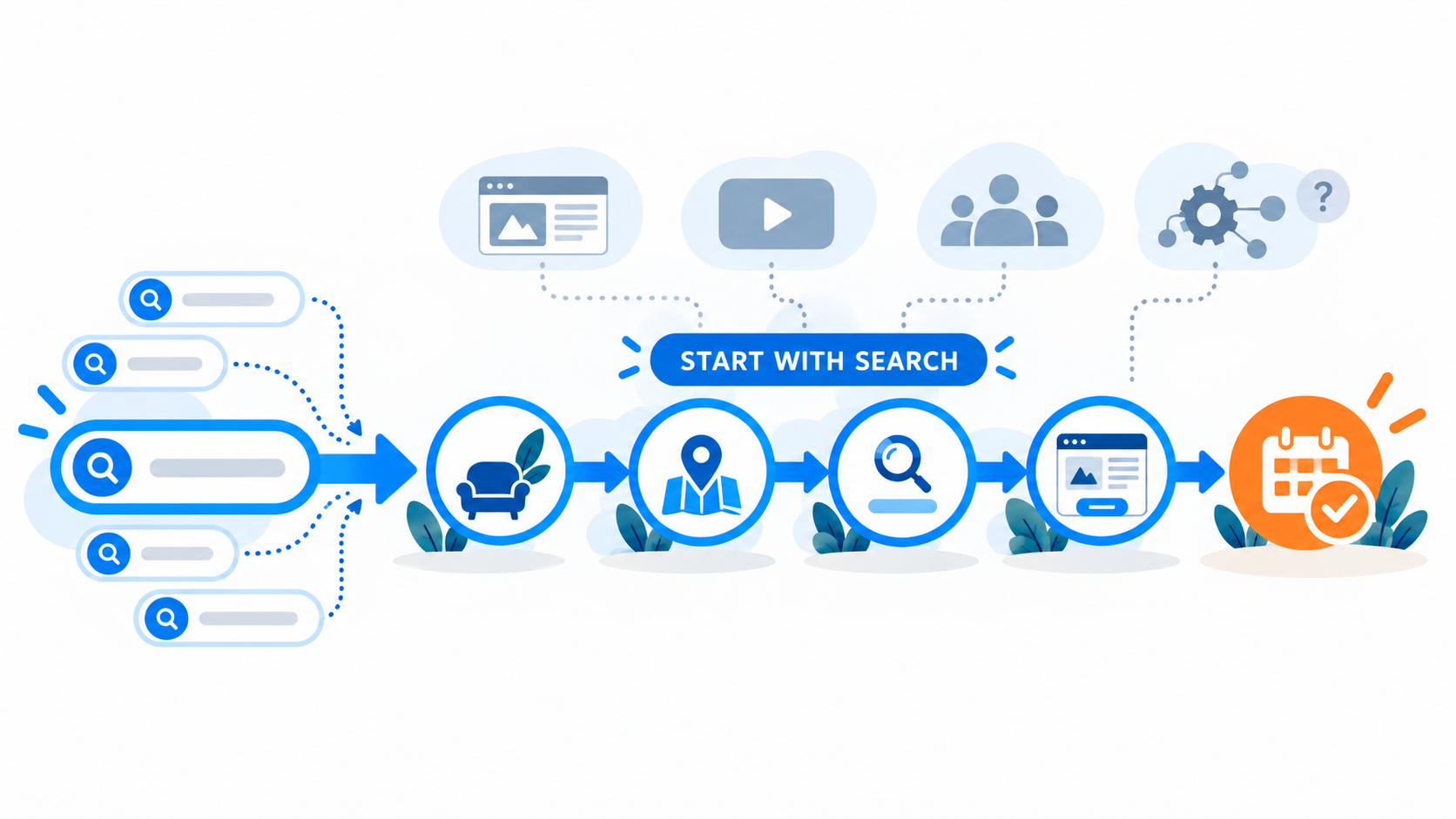
Google offers Search, Display, Demand Gen, YouTube, and Performance Max campaigns. More channels do not automatically produce more clients.

For most therapy practices, Search is the clearest starting point because it captures expressed intent. It also provides more visibility into which searches triggered the ads and which pages received the traffic.

Performance Max may become useful later, but it gives Google more freedom across placements and signals. Without dependable conversions, that freedom can optimize toward actions that look valuable inside the platform but do not represent qualified therapy clients.

Before expanding beyond Search, the practice should know which services, locations, searches, and landing pages produce qualified inquiries.
Location Targeting for In-Person and Telehealth Therapy

In-person practices should target only locations people can realistically travel from. Telehealth campaigns should target states where the therapist is licensed and clearly state that the service is online.

Google uses several signals to estimate location and states that geographic targeting is a best effort rather than perfectly accurate. Its location-targeting guidance is available here.

A practical structure includes separating in-person and telehealth messaging, mentioning the location in the ad and landing page, excluding jurisdictions where the provider cannot accept clients, and reviewing matched locations instead of trusting the settings blindly.

Where Should the Ad Send People?

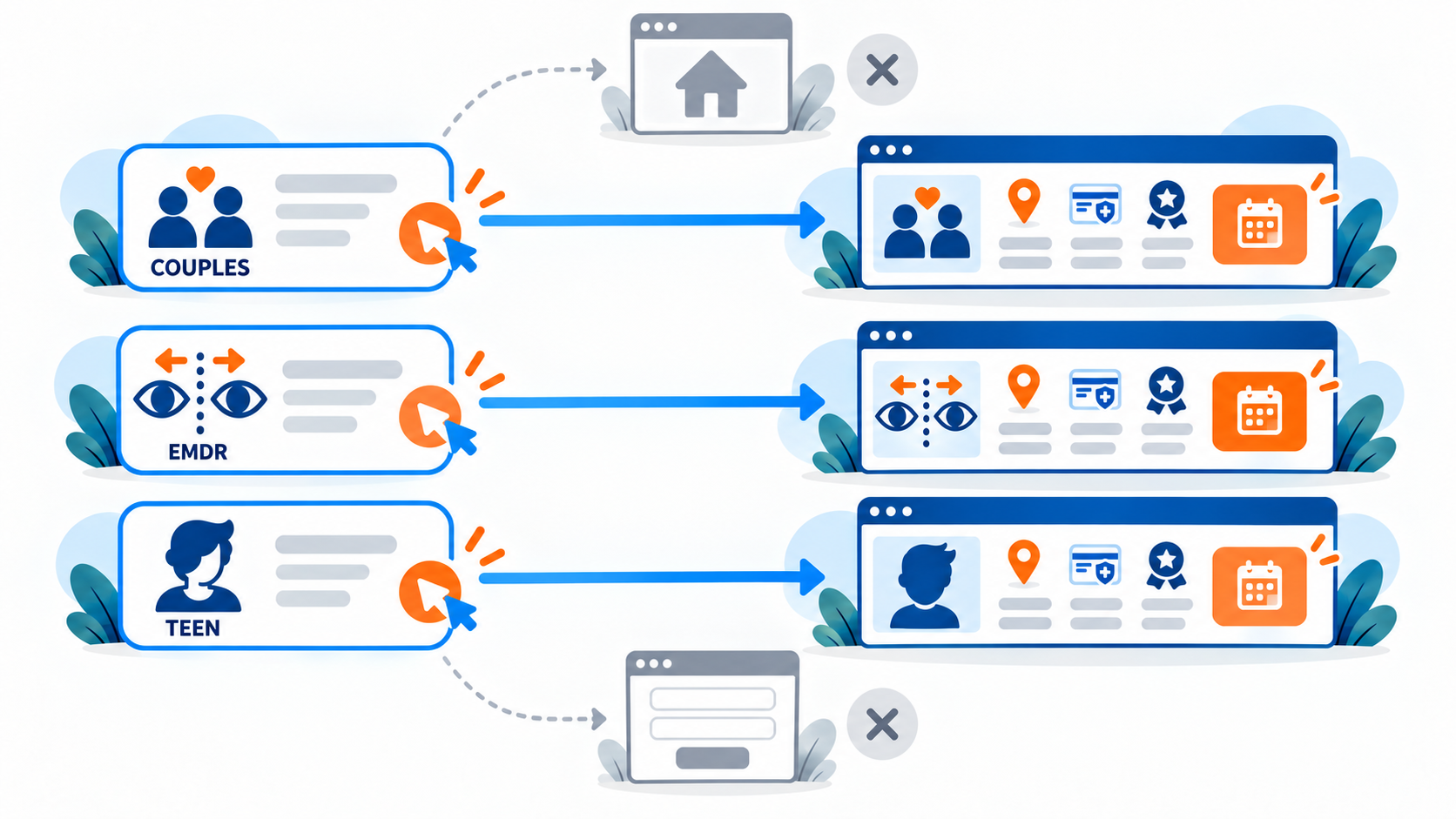
The best destination is usually the most relevant page, not automatically the homepage and not automatically a stripped-down landing page.

Couples ads should lead to a couples counseling page. EMDR ads should lead to an EMDR page. Teen therapy ads should lead to a teen therapy page.

Search behavior can be different for psychiatry and other higher-consideration services. Potential patients may research the provider, treatment options, insurance, and practice before converting. In those cases, a fuller service page with credible provider information may outperform a short page that feels like little more than a lead form.

The page should help visitors confirm that the practice offers the right service, works with people like them, is available in their location, accepts their insurance or explains private-pay fees, and makes the next step clear.

The goal is not to bury potential clients in educational content. It is to help them feel confident that contacting the therapist is an appropriate next step.
Conversion Tracking and Intake Matter as Much as the Ads

If Google can see clicks but cannot identify genuine inquiries, it cannot learn which searches are valuable. The practice cannot evaluate the campaign either.

Track completed contact forms, qualified phone calls, consultation bookings, and relevant appointment requests. Do not count every button click or contact-page view as a primary lead.

External forms, scheduling platforms, and assessment tools need special attention. In one mixed counseling and TMS account, four confirmed TMS conversions were recorded on approximately $600 in spend, or about $150 per recorded conversion. An external assessment form may have prevented other actions from being captured. Incomplete tracking made the campaign harder to evaluate accurately.

The intake process can create the same problem. Several forms may arrive while nobody documents whether those people were reached, scheduled, or qualified.

A stronger process includes immediate confirmation, fast staff notifications, same-business-day responses whenever possible, clear information about availability and fees, easy consultation scheduling, and tracking from inquiry to scheduled client.

Someone contacting a therapist may already feel uncertain about reaching out. A slow or confusing response gives them a reason to contact another practice.

Measure Clients, Not Just Leads

The complete path is:

Search → Click → Inquiry → Consultation → Appointment → Client

Imagine two campaigns:

  • Campaign A generates 20 leads at $60 each, but only two become clients.
  • Campaign B generates 10 leads at $100 each, but five become clients.

Campaign A has the cheaper lead. Campaign B has the lower client-acquisition cost.

This is particularly important for private-pay practices. The cheapest lead is not always the best lead.

Should You Hire Someone to Run Your Google Ads?

Therapists can manage Google Ads themselves, but the platform requires more than launching a campaign and checking the number of clicks.

DIY management may be realistic when the campaign is small, the therapist has time to learn the platform, and conversion tracking is already working. Hiring help usually makes more sense when the practice has multiple services or locations, is spending consistently, cannot diagnose poor lead quality, or does not have time to review search terms and follow-up data.

The person managing the campaign should understand therapy-specific search intent, privacy restrictions, landing pages, conversion tracking, and the difference between a form submission and an acquired client.

Want a partner who already knows therapy search intent? See our Google Ads management for therapists

Frequently Asked Questions

How much should a therapist spend on Google Ads?

A focused campaign can sometimes begin at $10 to $20 per day. Competitive cities, multiple services, and larger group practices may require more. The budget should reflect local click costs, available openings, and an acceptable cost per acquired client.

What campaign type is best for therapists?

Search is usually the strongest starting point because it reaches people actively looking for a therapist or counseling service.

Should therapists use broad match?

Broad match can work when tracking is accurate, negative keywords are mature, and the account has enough useful conversion data. New or limited-budget campaigns usually benefit from starting with phrase and exact match.

How can a therapist tell whether Google Ads are profitable?

Track inquiries through consultations and new clients. Cost per lead alone is not enough. The most useful measure is cost per acquired client compared with the expected value of that client.

Want a Clearer Answer for Your Practice?

Google Ads performance depends on location, specialty, competition, website quality, and intake. A strategy that works for a couples practice in a smaller city may be completely wrong for a psychiatry group advertising across an entire state.

J Curve Advertising specializes in marketing for therapists, counselors, psychiatrists, and mental health practices. The process starts with reviewing the market, website, Google Ads account, tracking, and intake flow to find the strongest opportunity.

Schedule a free 30-minute strategy session to discuss what is most likely to work for your practice.

Sources and Further Reading

Janko Jankovic
About the Author
Janko Jankovic

Janko has been in digital marketing since 2017 and founded J Curve Advertising in 2019, where he's built the agency around marketing for therapists, counselors, and mental health practices.

Book a Free 30-Minute Consultation

Related articles

In this article
Want more therapy clients?

Get a free, no-pressure review of your Google Ads, website, and local search presence from a Google Partner agency that specializes in mental health practices.